CXC chemokines located in the 4q21 region are up-regulated in breast cancer.
Résumé
Recent data suggest that chemokines could be essential players in breast carcinogenesis. We previously showed that the CXC chemokine CXCL8 (interleukin-8) was overexpressed in estrogen receptor alpha (ERalpha)-negative breast cell lines. Analysis of CXCL8 chromosomal location showed that several CXC chemokines (CXCL1, CXCL2, CXCL3, CXCL4, CXCL4V1, CXCL5, CXCL6, CXCL7, and CXCL8) were localized in the same narrow region (360 kb in size) of chromosome 4. We thus hypothesized that they could belong to the same cluster. Quantification of these chemokines in breast tumors showed that samples expressing high CXCL8 also produced elevated levels of CXCL1, CXCL3, and CXCL5, and displayed low content of ERalpha. CXCL1, CXCL2, CXCL3, CXCL5, and CXCL8 were co-regulated both in tumors and in breast cancer cell lines. CXCL5 and CXCL8 were mainly produced by epithelial cells, whereas CXCL1, CXCL2, and CXCL3 had a high expression in blood cells. The overexpression of these chemokines in tumor cells was not the result of gene amplification, but rather of an enhanced gene transcription. Our data suggest that high CXCL8 expression in tumors is mainly correlated to activating protein-1 (AP-1) pathway and to a minor extent to NF-kappaB pathway. Interestingly, CXCL1, CXCL2, CXCL3, CXCL5, CXCL6, and CXCL8 chemokines were present at higher levels in metastases when compared with grade I and III biopsies. High levels of CXCL8, CXCL1, and CXCL3 accounted for a shorter relapse-free survival of ERalpha-positive patients treated with tamoxifen. In summary, we present evidences that multiple CXC chemokines are co-expressed in CXCL8-positive breast tumors. In addition, these chemokines could account for the higher aggressiveness of these types of tumors.
Domaines
Cancer
Fichier principal
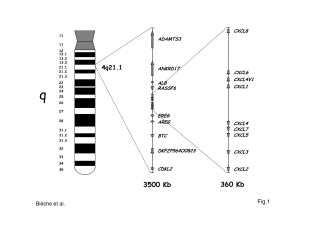 figure1.pdf (35.34 Ko)
Télécharger le fichier
Lazennec_manuscript.pdf (257.63 Ko)
Télécharger le fichier
Table_1S.pdf (10.47 Ko)
Télécharger le fichier
figure2.pdf (18.63 Ko)
Télécharger le fichier
figure3.pdf (11.47 Ko)
Télécharger le fichier
figure4.pdf (91.66 Ko)
Télécharger le fichier
tables.pdf (38.5 Ko)
Télécharger le fichier
figure1.pdf (35.34 Ko)
Télécharger le fichier
Lazennec_manuscript.pdf (257.63 Ko)
Télécharger le fichier
Table_1S.pdf (10.47 Ko)
Télécharger le fichier
figure2.pdf (18.63 Ko)
Télécharger le fichier
figure3.pdf (11.47 Ko)
Télécharger le fichier
figure4.pdf (91.66 Ko)
Télécharger le fichier
tables.pdf (38.5 Ko)
Télécharger le fichier
Origine : Fichiers produits par l'(les) auteur(s)
Origine : Fichiers produits par l'(les) auteur(s)
Format : Autre
Origine : Fichiers produits par l'(les) auteur(s)
Origine : Fichiers produits par l'(les) auteur(s)
Origine : Fichiers produits par l'(les) auteur(s)
Origine : Fichiers produits par l'(les) auteur(s)